
How Do You Read Labels on Wellness Tonics?
Last Updated: November 8, 2026
Quick Summary
To read wellness tonic labels, first check whether the bottle carries a Nutrition Facts or Supplement Facts panel, then read the serving size and servings per container. Next check calories, added sugars, and the ingredients list, which is ordered from largest amount to smallest.
- Find the serving size first, since every number on the panel refers to that amount.
- Check whether the panel is Nutrition Facts or Supplement Facts, because the format signals how the product is regulated.
- Read added sugars on their own line under Total Sugars, even when honey is the sweetener.
- Ingredients are listed by weight, so an item near the end is present in a small amount.
- Treat front-label words like wellness or gut as marketing, and confirm them on the back panel.
Table of Contents
- Why Wellness Tonic Labels Are Worth Reading Closely
- How to Read the Nutrition Facts Label on a Tonic Bottle
- Using the Ingredients List on Food Labels to Spot What Matters
- What Percent Daily Value Means and How to Use It
- How to Compare Serving Sizes on Beverage Labels
- Added Sugars, Botanicals, and Claims on Small-Format Drinks
- Checking Your Next Tonic Label, Step by Step
- Frequently Asked Questions
Why Wellness Tonic Labels Are Worth Reading Closely
Wellness tonic labels tell you what is in the bottle, how much you get, and how the drink is meant to be used. Most tonic bottles publish this information, and reading it takes about two minutes. Most people skip the label and go straight to the marketing on the front. That habit makes it harder to compare one tonic with another.
A tonic label can also be harder to read than a soda label. Many tonics combine apple cider vinegar, honey, ginger, and turmeric in one small bottle. Each ingredient adds calories, sugar, and flavor, and each one is listed in a specific way. Learning the layout once makes every future label faster to check.
Watch out: A bold word on the front, such as "wellness" or "gut," is a marketing claim, not a fact about the contents. Check the back panel and ingredient list before you decide.
How to Read the Nutrition Facts Label on a Tonic Bottle
The Nutrition Facts panel is the box that shows calories, fat, sodium, carbohydrates, sugars, and protein. The Food and Drug Administration sets the format for this panel on most packaged foods and beverages, and you can read the full rules on the agency's website at FDA Nutrition Facts Label requirements.
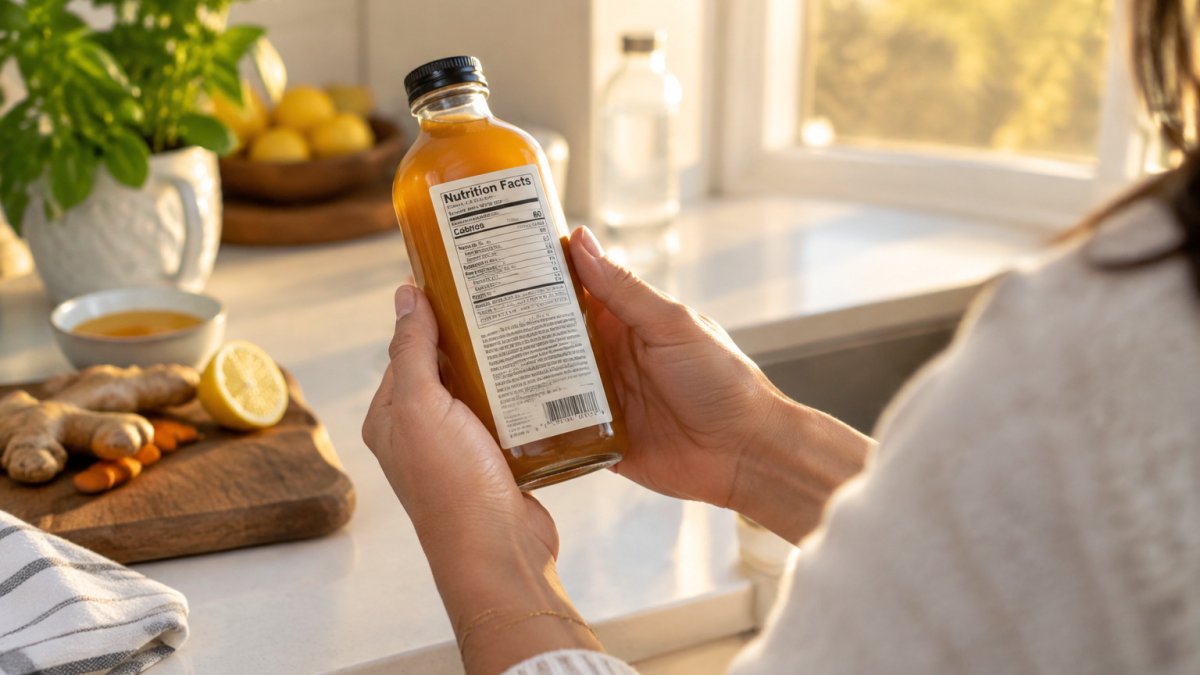
First, check which panel you are looking at. Tonics are sold under two different label formats, and the format tells you how the product is regulated:
- Nutrition Facts appears on products marketed as conventional foods and beverages. It reports calories and nutrients per serving in the standard grid.
- Supplement Facts appears on products marketed as dietary supplements. It reports "Amount Per Serving" and "% Daily Value" for each dietary ingredient, and it can list botanicals in a separate section.
A tonic sold as a beverage will carry Nutrition Facts. A tonic sold as a supplement will carry Supplement Facts. The two panels are not directly comparable line by line, so note which one you are holding before you start comparing brands.
Then read the Nutrition Facts panel in this order:
- Find the serving size first. Everything else on the panel is based on this amount.
- Check servings per container. A small bottle may hold more than one serving.
- Read the calories per serving. Multiply by the number of servings you plan to drink.
- Look at total sugars and added sugars. Vinegar tonics often use honey or fruit juice for flavor.
- Scan sodium and carbohydrates. These numbers show how the drink fits into your daily intake.
- Check the vitamins and minerals line. Tonics sometimes add vitamin C or other nutrients, and the %DV shows how much a serving contributes.
Most people drink a tonic in one or two shots. Doubling the amount means doubling every number on the panel. Keep that in mind before you pour a second shot.
If the bottle carries Supplement Facts instead, read the serving size and servings per container the same way, then look at the amount per serving for each listed ingredient. Pay attention to whether the panel lists a specific amount for each botanical or groups several into a proprietary blend with one combined amount. A blend tells you the total, not the individual amounts.
Watch out: A product can look like a beverage on the shelf and still carry Supplement Facts, or the reverse. The panel format, not the bottle shape or the front label, tells you which set of rules applies.
The two label formats you will see on tonic bottles follow different rules, and the table below shows how to tell them apart and what to read first on each.
| Label panel | Used on | What it reports |
|---|---|---|
| Nutrition Facts | Beverages sold as conventional foods | Calories and nutrients per serving |
| Supplement Facts | Products sold as dietary supplements | Amount per serving and % Daily Value per ingredient |
| Serving size | Both panels | The base amount every number refers to |
| Servings per container | Both panels | How many servings the bottle holds |
| % Daily Value | Both panels | Share of a 2,000-calorie daily diet |
Using the Ingredients List on Food Labels to Spot What Matters
Ingredients are listed by weight, from the largest amount to the smallest. If water is first, the drink is mostly water. If honey or juice appears near the top, sweetness is a major part of the recipe.
Bite Me Tonic 16 Days lists its ingredients as filtered water, organic apple cider vinegar, Manuka honey, organic ginger juice, organic lime and lemon juice, organic cayenne pepper, Hydromeric turmeric, and organic black pepper. Read the list from top to bottom and ask yourself which items you recognize and which ones you want to limit.
- Look for added sugars, such as cane sugar, syrup, or concentrated juice
- Check for flavorings, colors, and preservatives
- Note any ingredient you react to, such as onion or garlic
- Compare the list with your own dietary needs
The ingredients list shows what is in the bottle, not how the ingredients work in your body. Use it to decide whether a product fits your routine.
What Percent Daily Value Means and How to Use It
The percent Daily Value (%DV) shows how much a serving contributes to a standard daily diet. The FDA uses a 2,000-calorie diet as the reference point, according to its guidance on the FDA Daily Value reference guidance page.
A %DV of 5% or less is considered low. A %DV of 20% or more is considered high. These cutoffs help you judge a nutrient quickly without doing math. For example, a tonic with 20% DV for sodium would supply a fifth of the sodium a typical adult needs in a day.
Watch out: Your own needs may differ from the 2,000-calorie reference. If you have a medical condition or follow a special diet, check the numbers against your own goals.
How to Compare Serving Sizes on Beverage Labels
Serving sizes make it hard to compare drinks. One tonic may list a 1-ounce serving, while another lists 2 ounces. The nutrition numbers on each label apply only to its own serving size.
To compare two tonics fairly:
- Write down the serving size from each label
- Convert both to the same unit, such as ounces or milliliters
- Divide the calories and sugars by the serving size to find the amount per ounce
- Compare the amounts per ounce, not the amounts per bottle
This check takes less than a minute and can change which tonic looks like the better buy. A bottle with more servings may cost more but offer a lower price per serving.
Added Sugars, Botanicals, and Claims on Small-Format Drinks
Small bottles can hide a lot of sugar, and they can also hide a lot of vague language. Read this section with the bottle in hand.
Added sugars. Added sugars are sugars put into the drink during production, including honey, agave, maple syrup, cane sugar, and fruit juice concentrates. The Nutrition Facts panel lists them on their own line under Total Sugars, so you do not have to guess. A tonic sweetened with Manuka honey still counts that honey as an added sugar on the panel, even though honey sounds more natural than cane sugar.
Botanicals without amounts. Ginger, turmeric, cayenne, black pepper, and similar ingredients often appear in the ingredients list with no quantity. The list is ordered by weight, so a botanical near the end is present in a small amount. Three label patterns are worth knowing:
- Named amounts. The label states a milligram amount per serving, such as "ginger root extract 500 mg." This is the most transparent format.
- Extract ratios. A label may say "4:1 extract" or "10:1 extract," meaning the raw botanical was concentrated. A 10:1 extract at 100 mg represents roughly 1,000 mg of raw material, but the ratio alone does not tell you the final amount in the bottle.
- Proprietary blends. A single milligram amount covers a group of ingredients, and the individual amounts are not disclosed. You know the total, not the split.
If the amount of a botanical matters to you, look for a named milligram amount per serving, or contact the brand and ask. A label that lists a botanical only by name, with no amount and no ratio, gives you the least information.
Claims versus evidence. Front-label words like "wellness," "gut," "clean," and "functional" are marketing language, not regulated statements about what the drink does. The FDA does regulate certain claim categories on food labels, and the agency publishes guidance on how those claims are reviewed at FDA food labeling and claims guidance. Nutrient-content claims, such as "good source of fiber," are tied to defined thresholds. Read any claim as a description of ingredients, not as proof of an outcome.
A quick label test. Cover the front of the bottle with your hand and read only the back. If the back panel and ingredients list support the story the front is telling, the label is doing its job. If the front makes a promise the back cannot back up, you have your answer.
Checking Your Next Tonic Label, Step by Step
Use this checklist every time you pick up a new bottle:
- Find the serving size and the number of servings per container.
- Read the calories and sugars per serving.
- Check added sugars, sodium, and carbohydrates.
- Read the ingredients list from top to bottom.
- Look up any ingredient you do not recognize.
- Compare the price per serving with a similar product.
- Ignore front-label claims until you confirm them on the back.
If you want to see how these steps apply to a real product, check the label on the Bite Me Tonic 16 Days product page. The label lists its serving size, ingredients, and nutrition details in the same format described above. For a broader look at choosing a tonic that fits your needs, read our guide to choosing a wellness tonic. If you want to learn more about the botanicals in this tonic, see our deep dive into the functional ingredients.

Reading labels is the fastest way to know what you are drinking. Bite Me Wellness Tonic puts its full ingredient list and serving details on every bottle, so you can check the facts before you buy. Choose the pack size that fits your routine and start with one shot a day to see how it fits.
Frequently Asked Questions
How do you decode a nutrition label on a wellness tonic?
Start with the serving size at the top of the Nutrition Facts panel, then check how many servings the bottle holds. Every number below it, including calories, sugars and %DV, applies to one serving only. If you drink the whole bottle, multiply each figure by the number of servings. Next, read the ingredient list, which is ordered by weight, so the first few items make up most of the drink. Finally, check whether the panel is a Nutrition Facts or a Supplement Facts panel, since the two follow different rules.
What should you look for on a wellness tonic ingredient list?
Look first at the top three ingredients, since they make up the bulk of the product. Check for added sugars, sweeteners such as honey or syrup, and any botanical ingredients listed with a specific amount. Bite Me Tonic, for example, lists filtered water, organic apple cider vinegar, Manuka honey, organic ginger juice, citrus juices, organic cayenne, turmeric and organic black pepper. Ingredients listed without quantities make it harder to judge how much of each you are getting.
What does percent Daily Value mean on a Nutrition Facts label?
The %DV tells you how much of a nutrient one serving provides toward a daily reference amount for a typical adult diet, which is based on a 2,000-calorie day. A 5% DV is considered low and 20% or more is considered high. Because %DV is calculated per serving, it helps most when comparing two products of the same size. It does not indicate whether a product is effective for any health purpose.
