
How to Choose Authentic Manuka Honey for Bold Mocktails
Last Updated: November 17, 2026
Quick Summary
To choose authentic manuka honey, read the label for four things: stated country of origin, a specific UMF or MGO rating, the name of the independent certifier, and a batch number. Then enter that batch number on the certifier's website and confirm the certificate matches the label exactly.
- Words like manuka blend or manuka-type on a label are worth questioning.
- MGO shows methylglyoxal level in mg/kg; UMF is a licensed grade combining several markers.
- A batch lookup that returns no result is a reason to ask the seller for the certificate.
- Divide jar price by net weight in ounces and compare only jars of the same grade.
- Color, aroma and texture vary by harvest and are easy to replicate, so they prove nothing.
Table of Contents
- Why Manuka Honey Authenticity Matters in a Mocktail Glass
- Manuka Honey Label Guide: What Every Jar Should Tell You
- UMF vs. MGO Manuka Honey: Reading the Two Ratings
- Manuka Honey Authenticity and Certification: How to Verify a Jar
- Matching Grade to Use Without Overpaying
- Why Appearance, Taste, and Texture Prove Nothing
- Storing and Serving Honey-Based Concentrates
- Mixing a Drink Worth Looking Forward To
- Frequently Asked Questions
Why Manuka Honey Authenticity Matters in a Mocktail Glass
If you are learning how to choose authentic manuka honey, start with the label, not the price. Genuine manuka honey carries a rating that ties a specific batch to a specific potency, and that rating is what separates a real jar from a look-alike. At Bite Me Wellness Tonic, we build our mixer around manuka honey because it brings rounded sweetness that balances the tang of organic apple cider vinegar and the warmth of ginger. A mocktail lives or dies on that balance. Fake or mislabeled honey flattens it.
Here is an important point to keep in mind. Manuka honey is a product where fakes are not always obvious. A jar can look dark, taste rich, and still be ordinary honey with a fancy label. So we judge a jar by its paperwork, not its appearance. Below, we walk through the labels, the two rating systems, and the batch checks that tell you what is actually in the bottle.
Manuka Honey Label Guide: What Every Jar Should Tell You
A real manuka honey label answers four questions before you open the lid: where the honey came from, what it is rated for, who certified it, and which batch it belongs to. If any of those is missing or vague, put the jar back.
The Four Things to Read Before You Buy
- Origin: Look for the stated country of origin on the label.
- Rating: A specific UMF or MGO number, not just the word "manuka."
- Certifier: The name of the independent body that tested and licensed the rating.
- Batch number: A code you can match to a certificate or lab result.
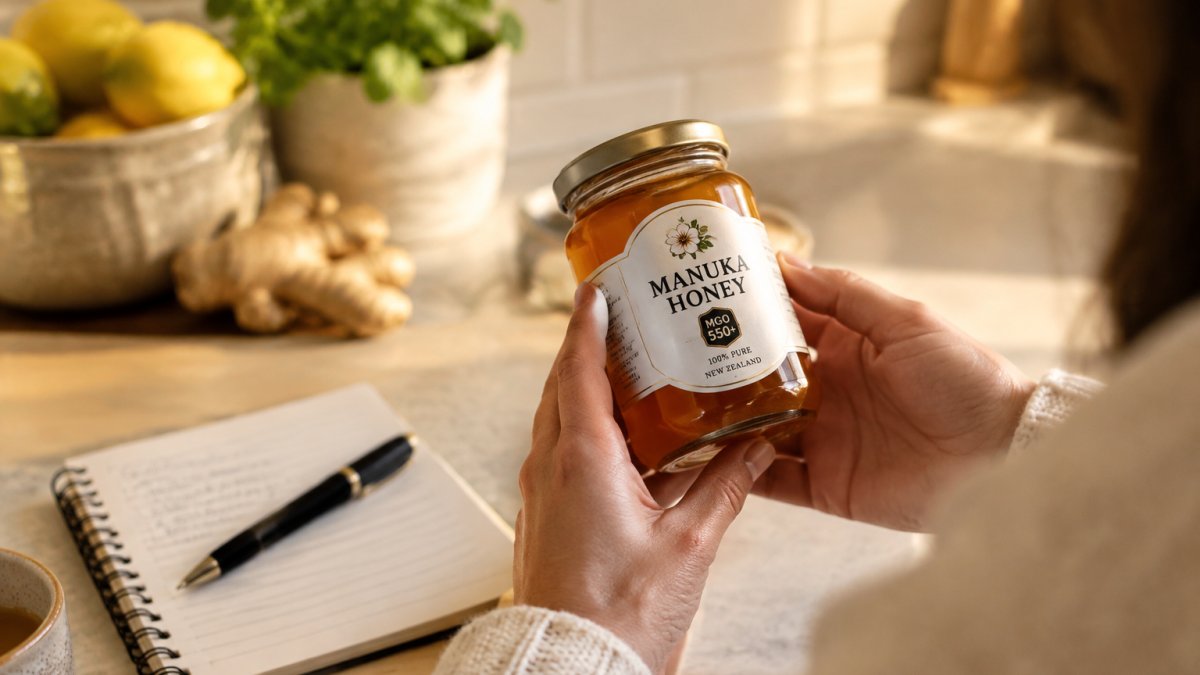
Words like "manuka blend" or "manuka-type" are worth questioning on the label. For a guide to the red flags on a printed label, see how to spot fake Manuka honey labels.
UMF vs. MGO Manuka Honey: Reading the Two Ratings
The UMF and MGO ratings measure related things on different scales. MGO refers to methylglyoxal, a compound found in manuka honey, and an MGO number on a label indicates its measured level. UMF, or Unique Manuka Factor, is a grading system that combines several marker compounds.
What the Numbers Actually Mean
| Rating System | What It Measures | How It Reads | Best For |
|---|---|---|---|
| MGO | Methylglyoxal level in mg/kg | A single number, such as MGO 100 or MGO 400 | Quick potency comparison |
| UMF | Combined markers plus MGO, under license | A grade, such as UMF 5+ or UMF 15+ | Verified authenticity |
Higher numbers mean a more potent, more expensive jar. For everyday mixing, you do not need the top grade. A moderate rating gives you the rounded sweetness and depth you want without the premium price. The UMF Honey Association grading standards explain how the licensed grades are assigned.
Manuka Honey Authenticity and Certification: How to Verify a Jar
Verification takes about five minutes and a phone. Genuine manuka honey authenticity and certification rest on independent testing, so the goal is to confirm that a real lab, not the brand itself, signed off on the batch. A certificate is only useful if you can match it to the jar. Here is what to actually look for once you have it in front of you.
A Five-Minute Batch Check
- Find the batch or lot number on the jar. It is usually printed near the best-by date, sometimes stamped on the lid or etched into the glass.
- Go to the certifier's website and enter that number in its license or batch lookup.
- Confirm the rating on the certificate matches the label exactly, a UMF 10+ jar should return a UMF 10+ record, not a lower grade.
- Check that the producer is listed as a licensed user of the mark, not just a brand that prints the letters.
- Compare the harvest or packing date on the certificate to the batch record on the jar. A certificate dated years before the jar was packed is a mismatch worth questioning.
What a Real Certificate Shows
A useful certificate is more than a logo. It should name the producer and the batch or lot, and ideally the testing laboratory and date of testing. If the document only shows a grade with no batch number, treat it with caution.
When the Lookup Fails
A batch number that returns no result is not automatically proof of a fake, but it is a reason to stop and ask. Common causes are a typo in the code, a very new batch not yet loaded, or a seller reselling jars outside the licensed channel. Ask the seller for the certificate directly and compare the batch number on it to the jar in your hand. A trusted seller will send it without hesitation. If the numbers do not line up, walk away.
Watch out: a screenshot of a certificate is easy to fake. Ask for the batch number and run the lookup yourself rather than trusting an image the seller sends.
For a deeper step-by-step walkthrough, our guide on how to know if Manuka honey is real covers the full verification process.
Matching Grade to Use Without Overpaying
Match the grade to the job, not to the biggest number on the shelf. A high rating costs more per gram, and in a mixed drink the subtle differences fade behind citrus, ginger, and spice. The trick is to compare value the same way you would compare any pantry staple: by what you get per unit, not by the number on the front.
What Drives the Price
Several factors affect a jar's price, including potency, jar size, and packaging or retail channel. None of these tells you which jar is right for your glass.
A Simple Value Comparison
Divide the jar price by the net weight in ounces to get a cost per ounce, then compare that figure only among jars of the same grade. A UMF 10+ at one cost per ounce and a UMF 15+ at a much higher cost per ounce are not competing for the same job. This is the comparison most buyers skip, and it is where overpaying happens.
Matching Grade to the Job
- Daily spoonful or tea: a lower to moderate grade is plenty.
- Cooking and baking: moderate grade holds up against heat and other flavors.
- Straight from the spoon: a higher grade if you want the full intensity.
- Mixing into drinks: moderate grade, judged on flavor and value.
For a mocktail mixer, a moderate grade can deliver the rounded sweetness and body you want. The honey is there to round off the tang of apple cider vinegar and the warmth of ginger, not to be the star of the glass. Paying for the top grade and then drowning it in a sweet mixer wastes both the honey and your money.
When you are ready to act on this, our authentic Manuka honey brands buyer's guide compares verified options so you can pick a grade with confidence.
Why Appearance, Taste, and Texture Prove Nothing
You cannot verify manuka honey by looking at it. Color, aroma, and texture vary by harvest, season, and floral source, and counterfeiters replicate all three with ease. A dark, thick honey with a rich aroma may be ordinary honey blended to mimic the real thing.
What actually proves a jar is the paper trail: independent testing, a licensed rating, and a batch number that resolves to a certificate. Rely on those markers, not your senses. This is the single biggest mistake we see buyers make. They trust the drizzle and skip the database.
Storing and Serving Honey-Based Concentrates
Store honey-based concentrates with the cap tight and keep water out of the jar. A spoon kept dry and clean prevents contamination.
For serving, treat a concentrate like the flavor base it is. Shake the bottle before pouring, measure a serving, and dilute to taste. Bite Me Wellness Tonic is bottled exclusively in glass, and each 16 fl oz bottle provides 16 servings of about 1 fl oz each. Taste before adding extra sweetener or citrus, since the honey already brings sweetness and the vinegar brings tang. For more on keeping a jar at its best, see our guide on how to store Manuka honey.
Mixing a Drink Worth Looking Forward To
A great mocktail needs more than sweetness. Acidity, warmth, and depth give it complexity, and Bite Me brings all three in one pour. When the mixer already balances those notes, you can build an interesting drink with very little effort.
Try this suggested recipe, labeled as a suggestion rather than an official or tested brand recipe. Add 1 fl oz of Bite Me Tonic to a glass over ice, top with 4 fl oz of sparkling water, and stir gently. Garnish with a lemon wheel and a sprig of mint. For a richer pour, swap the sparkling water for ginger ale, which adds sweetness and reinforces the ginger. Adjust with a squeeze of lime if you want more brightness. Each bottle makes 16 drinks this way. For more ideas, browse our mocktail recipes and try our pear honey mocktail next.
The difference between a forgettable mocktail and one you crave comes down to the ingredients you start with. Bite Me Wellness Tonic is made with organic apple cider vinegar with the mother, manuka honey, ginger, citrus, turmeric, and warming spices, all bottled in glass and rooted in our grandmother Marion's family recipe. Shake, measure, and mix your way to a drink worth looking forward to. Get started with Bite Me Wellness Tonic and build a mocktail you will actually crave.
Frequently Asked Questions
How do I know if manuka honey is genuine?
Check the jar for a UMF or MGO rating, a named producer, and a batch number you can look up. Manuka honey is typically identified through marker compounds such as methylglyoxal. If a label makes a potency claim but gives you no rating, no batch code, and no way to verify the producer, treat it as unproven. Manuka honey authenticity and certification come down to documented testing, not the word on the front of the jar.
Which is better, UMF or MGO?
Neither is better; they describe the same honey from different angles. UMF is a grading system that combines a potency grade with several marker compounds. MGO states the measured methylglyoxal content directly. Use whichever number is printed to compare jars.
Is a higher MGO rating always better?
No. Higher ratings cost more, and the difference only matters if you need that grade for a specific purpose. For everyday mixing, a moderate grade gives you the rounded sweetness and earthy depth you want without paying for potency you will not notice in a drink. Buy the grade that fits how you will use the jar, and remember that price per gram of honey is a fairer comparison between jars than the rating alone.
What is a sensible manuka honey grade for everyday use?
For stirring into mocktails, a lower to mid-range grade is usually the practical choice. You are buying flavor: rounded sweetness, a slightly earthy finish, and enough body to stand up to citrus and ginger. High-grade jars are typically reserved for eating by the spoonful. Compare a few jars at the same grade on price per gram, check the batch number is printed, and taste before you add extra sweetener to a drink.
