
How to Spot Fake Manuka Honey Labels: 7 Checks
Table of Contents
- Why Fake Manuka Honey Labels Are So Common
- How to Read Manuka Honey Labels: A Field-by-Field Checklist
- Authentic Manuka Honey Certification: Marks That Actually Mean Something
- UMF vs MGO Manuka Honey: What the Numbers Prove and What They Don't
- Manuka Honey Batch Number Verification: Tracing a Jar Back to Its Source
- Red Flags on a Fake Manuka Honey Label
- The Limits of At-Home Tests and What to Do With a Suspicious Jar
- Frequently Asked Questions
Last Updated: October 17, 2026
Why Fake Manuka Honey Labels Are So Common
Fake manuka honey is a labeling problem before it is a honey problem. Manuka honey sells at a higher price than most everyday honey, and that gap creates an opening for vague words, borrowed imagery, and jars that hint at a premium product without ever proving it.
Here is the core tension: most misleading jars are not illegal counterfeits. They are legal products using loose language. That makes reading the label your main defense.
How to Read Manuka Honey Labels: A Field-by-Field Checklist
Start with the front label, then flip the jar and read the back panel. The front sells a story. The back panel carries the facts you can actually check.
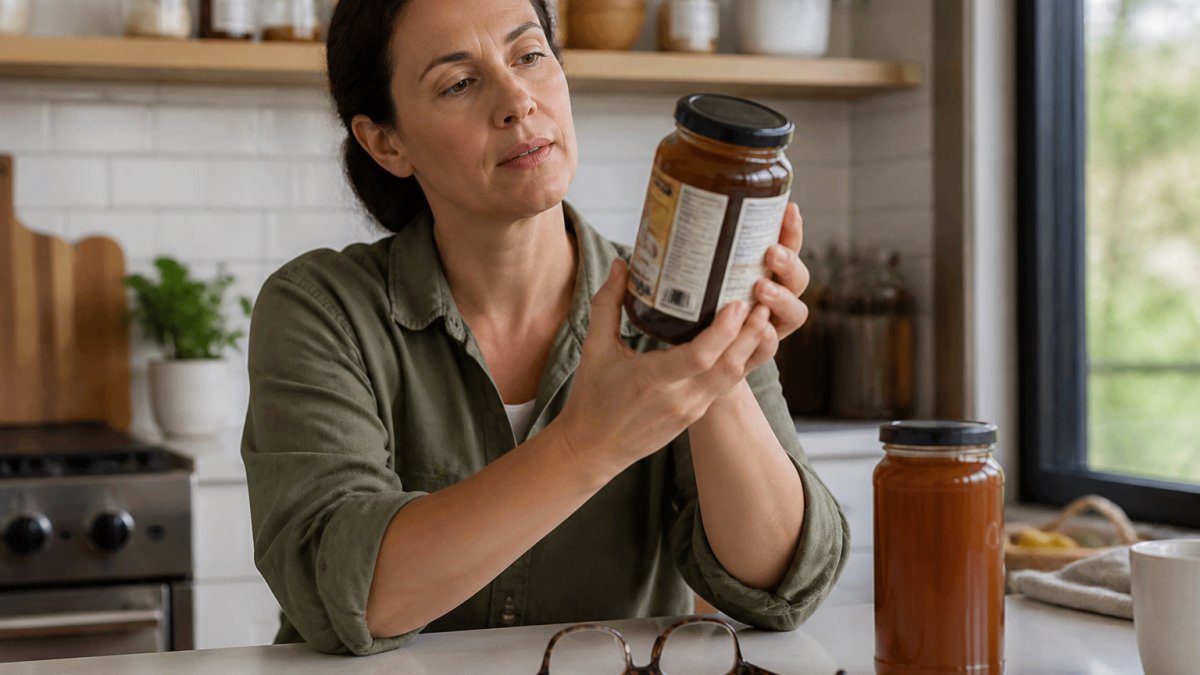
The Front Label vs. The Back Panel
The front label is marketing. The back panel is where the traceable details live. Work through these fields in order:
- Product name, Does it say "manuka honey," or does it say "honey blend" or "honey with manuka"?
- Origin statement, Look for a clear country of origin and whether the jar was packed there.
- Rating system, Is there an MGO or UMF number, or just the word "active"?
- Certification mark, Is there a recognizable, named certification logo?
- Batch or lot number, A real batch code lets you trace the jar.
- Producer details, A named producer or packer with a contact address.
- Ingredient list, Pure honey should list honey. Anything else deserves a second look.
A common mistake is trusting the front label alone. Most misleading jars look convincing from a foot away.
Authentic Manuka Honey Certification: Marks That Actually Mean Something
Authentic manuka honey certification is a named, independent program, not a decorative leaf or a "quality assured" badge. A real mark belongs to a specific body that tests and licenses producers, and it should be identifiable by name. The problem is that most shoppers have never been told which names to look for, so any fern-shaped logo can pass as official.
The certification marks worth knowing
Two programs dominate the manuka honey label landscape, and both are worth understanding before you shop:
- UMF Honey Association (UMF HA). This is the licensing body behind the UMF grade. It licenses producers to use the UMF mark, maintains a public list of licensed brands and products, and requires that rated honey meet defined methylglyoxal and other marker thresholds. The UMF mark is a licensed claim, which means a producer using it should appear in the association's own records.
- Ministry for Primary Industries (MPI) export requirements. Manuka honey exported from New Zealand must meet a scientific definition and testing regime administered under MPI. This is a regulatory framework, not a consumer logo, but it is the reason a jar can legally be called manuka at all. A label that references MPI-defined manuka is making a regulated claim rather than a marketing one.
A named program you can look up carries weight. A generic seal that names no issuing body, links to no member list, and appears on no certifier's website is decoration.
What a certification mark actually certifies
This is where most label-reading advice stops short. A certification mark is not a guarantee about the jar in your hand. It is a statement that a producer is licensed to use a mark and that the product line has met a program's testing requirements. What it does not do:
- It does not certify the specific jar. Certification is licensed at the product or producer level, not stamped onto each individual unit after testing.
- It does not prove the jar was stored correctly. Heat and light degrade honey after it leaves the packer, and no logo can vouch for the supply chain.
- It does not prove the jar is unopened or untampered. That is a packaging and retail question, not a certification question.
That distinction matters because a convincing logo on a jar with no batch code and no producer name is still an unverifiable jar.
How to verify a certification mark independently
Do not take the logo at face value. Work through these steps before you trust a mark:
- Read the mark's name. If it names no issuing body, stop there.
- Look up the issuing body. Find the certifier's official site and its list of licensed producers or products.
- Match the brand. Confirm the brand on the jar appears in the certifier's own records, not just on the jar's marketing page.
- Check the rating against the mark. If the jar claims a UMF grade, confirm the grade is one the program actually licenses.
- Confirm the mark is current. Licensing can lapse, so a mark that appears on an old label may not reflect current status.
UMF Honey Association licensed brands and products New Zealand Ministry for Primary Industries manuka honey export requirements
A certification mark proves a producer passed a program's checks. It does not prove the jar in your hand is unopened, correctly stored, or the same batch that was tested. That is why the batch number matters as much as the logo, and why the next step is tracing the jar, not just admiring the seal.
UMF vs MGO Manuka Honey: What the Numbers Prove and What They Don't
UMF vs MGO manuka honey comes down to two different ways of describing the same underlying compound. MGO refers to methylglyoxal, a naturally occurring compound in manuka honey. UMF is a grading system that factors in methylglyoxal alongside other measured markers. The two are related but not interchangeable, and treating them as the same number is one of the most common label-reading mistakes.
How the two systems relate
MGO is a measured value: a concentration of methylglyoxal in the honey, typically expressed in milligrams per kilogram. UMF is a grade: a licensed rating that a producer is authorized to print only when the honey meets a program's thresholds.
That means a jar can print an MGO figure without being UMF-licensed. The number may be real, but nothing behind it is independently checkable unless a named program stands behind it.
What the numbers prove
When a rating comes from a real lab and a named program, it proves a tested level of the compound in the batch that was tested. That is a meaningful data point. It tells you the honey was measured, and it tells you roughly how potent the batch was at the time of testing.
What the numbers do not prove
This is the part most label guides skip. A rating, even a licensed one, does not establish:
- Purity. A tested methylglyoxal level does not confirm the jar contains nothing but manuka honey.
- Origin. A rating is not a country-of-origin statement. Origin is a separate label field you have to check on its own.
- Monofloral source. A rating does not tell you whether the honey is monofloral or multifloral; that is a separate labeling question.
A high MGO number on an uncertified jar is a claim, not a result. Treat the number as one data point, not a verdict.
How to read a rating without over-trusting it
Use the rating as a starting filter, then verify the things it cannot tell you:
- Is the rating licensed? A UMF grade should be backed by a named program and a producer listing. An MGO figure should be traceable to a batch record.
- Does the jar also carry origin and batch details? A rating without origin and batch information is doing all the work alone.
- Does the label distinguish monofloral from multifloral? The rating does not answer that question for you.
- Can you trace the batch? If the producer cannot produce a batch record, the rating is unverifiable regardless of how large the number is.
The rating is one field on the label. The next section covers the field that ties all the others together: the batch number.
Manuka Honey Batch Number Verification: Tracing a Jar Back to Its Source
Manuka honey batch number verification is the step most buyers skip, and it is the one that separates a checkable jar from a hopeful one. A batch or lot code ties a specific production run to a producer's records.
How to trace a jar:
- Find the batch or lot code, usually printed on the back label or the lid.
- Go to the producer's or certifier's website and look for a batch lookup or verification tool.
- Match the code to the product, the rating, and the production details.
- If no lookup exists, contact the producer directly and ask for the batch record.
A producer who can answer a batch question quickly is a good sign. A producer who cannot is telling you something too.
Red Flags on a Fake Manuka Honey Label
Fake manuka honey labels share a handful of tells. Scan for these before you buy:
- "Active" or "bio-active" with no number. These words have no fixed meaning on a label.
- A rating with no program behind it. An MGO or UMF figure with no certifier and no batch code.
- Vague origin. "Product of multiple countries" on a jar marketed as manuka.
One red flag might be sloppy design. Three or more together is a pattern.
The Limits of At-Home Tests and What to Do With a Suspicious Jar
At-home authenticity tests cannot confirm manuka honey. The cremation test, the water test, and the thumb test show you texture and behavior. They do not measure methylglyoxal, and they cannot confirm origin. Real verification happens in a lab, through a named program, using batch records.
If a jar looks suspicious:
- Stop and document. Photograph the front label, back panel, and batch code.
- Check the batch. Try the producer's or certifier's lookup tool.
- Contact the seller. Ask for the certification details and the batch record in writing.
At Bite Me Wellness Tonic, we treat manuka honey sourcing as a label-reading exercise first.
Frequently Asked Questions
What should I look for on a Manuka honey label?
Start with four things: a specific MGO number (such as MGO 100+ or MGO 400+), a UMF grade if the brand claims one, a named New Zealand producer or packer, and a batch or lot number you can trace. Then check the back panel for a certification mark and independent laboratory testing language. Vague terms like "active" or "bio-active" without a number behind them tell you nothing about potency. A label that names the nectar source as monofloral Manuka is stronger than one that just says "honey blend."
What do UMF and MGO mean on Manuka honey labels?
MGO stands for methylglyoxal, a compound naturally present in Manuka honey, and the number on the label reflects its measured concentration. UMF is a grading system that bundles MGO together with other markers into a single grade. In practice, a higher number on either scale means a more potent jar. What neither number proves is that the honey is genuine on its own, which is why you pair the rating with a certification mark, a New Zealand origin claim, and a traceable batch number.
How can I verify a Manuka honey authenticity claim?
Work from the label outward. Write down the MGO or UMF number, the batch code, and the certifying body named on the jar. Then check the certifier's own directory to confirm the producer is listed, and contact the brand directly with the batch number to ask for the corresponding laboratory test results. A legitimate producer can match a batch code to a test report. If the brand cannot or will not connect a specific jar to a specific test, that is your answer.
Can I test Manuka honey at home to see if it's fake?
Not reliably. The home tests that circulate online, such as the thumb test, the water test, or the paper test, can tell you something about thickness or moisture content, but none of them detect methylglyoxal levels or confirm the nectar source. Adulterated honey can pass every one of them. The only meaningful check is a laboratory test tied to a batch number, which is exactly why traceability on the label matters more than any kitchen experiment.
Manuka honey is worth the price only when the label earns it. If you want manuka honey in a daily wellness routine without the guesswork of reading a dozen jars, our tonic is built for exactly that: organic apple cider vinegar, manuka honey, ginger, and turmeric in a ready-to-drink shot. Check our current lineup and let the label do the talking.