
How to Spot Fake Honey in the Grocery Store
Last Updated: November 6, 2026
Quick Summary
To spot fake honey in the grocery store, read the ingredient list first: real honey lists only honey, while anything with glucose, rice, corn, or beet syrup is not pure. Then check for a specific country of origin, floral source, and named packer, and put back any jar that fails two or more checklist items.
- Ultrafiltration strips pollen from honey, making its origin impossible to trace.
- Crystallization is natural in real honey and is a sign of authenticity, not a flaw.
- Home tests like the water, flame, thumb, and UV tests are not reliable proof of authenticity.
- Report mislabeled or adulterated honey to the FDA through its consumer complaint system.
- A legitimate producer will answer questions about origin and testing; a shell brand won't.
Table of Contents
- Why Fake Honey Ends Up on Grocery Shelves
- How to Tell if Honey Is Real in Store: A Grocery-Aisle Checklist
- Real Honey vs Fake Honey: What Actually Differs
- How to Identify Pure Honey by Looking at Color, Clarity, and Texture
- How to Check Pure Honey in Water, and Why Home Tests Fall Short
- Label Terms, Price, and Packaging: Clues, Not Proof
- What to Do When a Honey Product Seems Suspicious
- Choosing a Honey You Can Trust for Your Daily Wellness Routine
- Frequently Asked Questions
Why Fake Honey Ends Up on Grocery Shelves
Honey is one of the most commonly adulterated foods in the world, and the reason is simple economics. Real honey takes time, land, and bees. Sugar syrup takes minutes. When you learn how to spot fake honey in the grocery store, you're really learning to read the gap between what a label promises and what a jar actually contains.
At Bite Me Wellness Tonic, we use Manuka honey in our daily wellness shots, so we care deeply about this problem.
Here's the uncomfortable truth most guides skip: much of the fake honey on shelves isn't obviously fake. It looks like honey. It pours like honey. It may even taste decent. The deception usually happens before the jar is filled.
Common paths to a fake or adulterated product:
- Syrup blending during packing, often with rice, corn, or beet syrup
- Ultrafiltration that strips out pollen, making origin impossible to trace
- Mislabeled origin on jars blended from multiple countries
- Vague floral claims with no supporting paperwork
The FDA regulates honey as a food and prohibits misleading labels, but enforcement can be uneven, which leaves much of the detective work to the shopper.
How to Tell if Honey Is Real in Store: A Grocery-Aisle Checklist
The fastest way to tell if honey is real in store is to read the label before you read the price. A trustworthy jar tells you where the honey came from, what flower the bees visited, and who packed it. A suspicious jar tells you almost nothing.
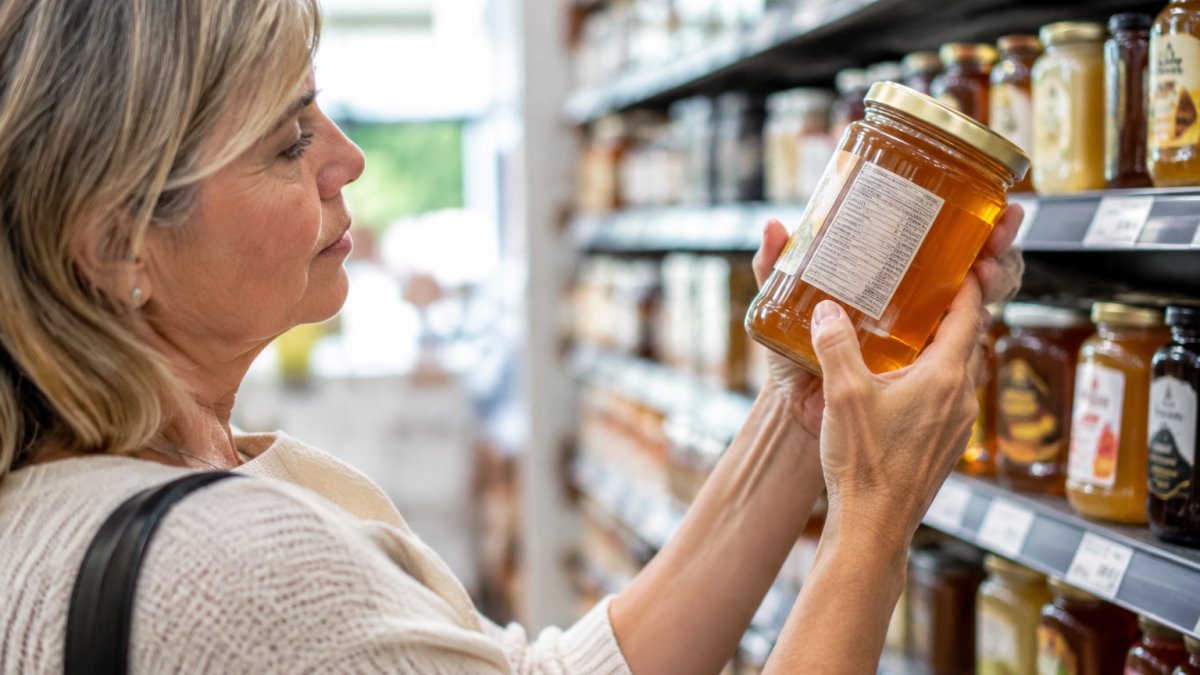
Here's a checklist shoppers can run through in under a minute:
- Ingredient list says only "honey" (no syrups, no "honey blend")
- Country of origin is named, not just "imported"
- Floral source is specific (clover, buckwheat, Manuka)
- Packer or producer is identified
- No claims that sound too good for the price
- Seal and lot number are intact
If a jar fails two or more of these, put it back.
Read the Ingredient List First
The ingredient list is your single best clue. Real honey needs one word: honey. If you see glucose syrup, high-fructose corn syrup, rice syrup, or sugar cane syrup, it's not pure honey, no matter what the front label says. The FDA requires ingredients to be listed by weight, so anything added shows up here.
Check Origin, Floral Source, and Traceability
Origin matters because honey is a product of place. A jar that names a specific region, a specific flower, and a specific producer is far harder to fake convincingly. Traceability, the ability to follow a jar back to a hive or a co-op, is the quiet hallmark of honest honey. For a deeper walkthrough of reading tricky labels, see our guide on how to spot fake Manuka honey labels.
Real Honey vs Fake Honey: What Actually Differs
Real honey is a complex, variable food made by bees from flower nectar. Fake honey is a manufactured approximation built to hit a price point. The difference shows up in pollen, enzymes, aroma, and how the honey behaves over time.
The table below sums up the practical differences you can look for:
| Feature | Real Honey | Fake or Adulterated Honey |
|---|---|---|
| Ingredient list | Honey only | Honey plus syrups |
| Pollen content | Present, traceable | Often filtered out |
| Origin label | Specific region | Vague or "imported" |
| Crystallization | Happens naturally | May stay syrupy forever |
| Aroma | Floral, layered | Flat or sugary |
| Price | Reflects scarcity | Suspiciously low |
What most guides miss is that pollen is the smoking gun. Ultrafiltration removes pollen so a blended product can't be traced to its source. If you want a focused breakdown of telling real from fake, our article on how to know if Manuka honey is real digs into the specifics.
How to Identify Pure Honey by Looking at Color, Clarity, and Texture
You can identify pure honey by looking, but color and clarity are clues, not proof. Real honey ranges from nearly clear to dark amber depending on the floral source. Clarity varies too. Some real honey is brilliantly clear, and some is cloudy with natural particles.
Texture tells a subtler story. Real honey is viscous, meaning it pours slowly and holds its shape on a spoon. Fake blends can feel thinner or oddly uniform. Aroma and taste finish the job: real honey smells like the flowers it came from.
Crystallization and What It Does Not Prove
Crystallization is natural. Real honey granulates over time, especially raw and unfiltered varieties, and that's a sign of authenticity, not a flaw. The myth that crystals mean fake honey is backwards. If you're worried about texture changing in your cupboard, learn how to store Manuka honey to keep it fresh.
How to Check Pure Honey in Water, and Why Home Tests Fall Short
The water test, the flame test, the thumb test, and the ultraviolet-light trick are the four home checks that circulate most widely online. Each one produces a dramatic result on camera, and each one is close to useless as proof of authenticity. Understanding why they fail is more useful than memorizing them.
The water test. A spoon of honey dropped into a glass of water is supposed to sink and clump if real, and dissolve if fake.
The flame test. A cotton swab dipped in honey is supposed to burn if the honey is pure and refuse to light if it is diluted.
The thumb test. A drop of honey on the thumb is supposed to hold its shape if pure.
The ultraviolet test. Shining a UV light on honey to look for fluorescence is a parlor trick.
Here is the mechanism that matters: honey is a supersaturated sugar solution with a small amount of water, plus trace pollen, enzymes, and organic acids.
Laboratory testing is the only reliable path. The methods that actually establish authenticity include:
- Pollen analysis (melissopalynology): A microscope count of pollen grains can identify the floral source and the geographic region. Ultrafiltration strips pollen out, which is itself a red flag because it destroys the traceability of the product.
- Stable isotope ratio analysis: This measures the ratio of carbon isotopes in the honey. Cane, corn, and rice syrups come from plants with a different photosynthetic pathway than the nectar sources bees visit, so the isotope signature can reveal added sugar.
- Sugar profile testing: High-performance liquid chromatography can detect the presence of syrups that do not match the natural sugar profile of honey.
- Nuclear magnetic resonance (NMR) profiling: This compares a sample against a reference database of authentic honeys and can flag anomalies that suggest adulteration.
These tests require equipment and reference libraries that consumers do not have. That is not a failure of consumer knowledge; it is the nature of the fraud. The practical takeaway is to treat home tests as entertainment, not evidence.
Label Terms, Price, and Packaging: Clues, Not Proof
Label language is where most honey fraud hides, because the words on the front of the jar are marketing and the words on the back are regulated.
Ingredient statements. Under FDA labeling rules, a food with more than one ingredient must list them by common name in descending order by weight.
Processing claims. "Raw" and "unfiltered" are marketing terms without a standard legal definition for honey.
Price. Real honey costs money to produce: land, hives, labor, and time. Single-origin and Manuka honeys cost more still.
Packaging. A producer willing to put a name, a region, a lot number, and a contact address on the jar is showing you their hand.
None of these clues is proof on its own. Stack them together, in this order: ingredient list first, origin second, processing claims third, price and packaging last.
What to Do When a Honey Product Seems Suspicious
If a jar looks wrong, you have options. Start by checking the label against the checklist above. If something seems off, note the brand, lot number, and store, then report it. Mislabeled or adulterated food can be reported to the FDA through its consumer complaint system.
You can also contact the manufacturer directly and ask about origin and testing. A legitimate producer will answer. A shell brand won't.
Don't rely on a single home test to condemn or clear a product, since these tests are not reliable proof of authenticity.
Choosing a Honey You Can Trust for Your Daily Wellness Routine
The safest path is to buy from producers who volunteer information: origin, floral source, and how the honey was handled. A buyer's guide helps here, and our roundup of authentic Manuka honey brands walks through what to look for.
At Bite Me Wellness Tonic, our daily tonic is crafted with organic apple cider vinegar, Manuka honey, ginger, and turmeric. Our blend offers a smooth, delicious taste without any harsh burn.
Spotting fake honey takes a sharp eye and a little patience, and the grocery aisle is where it counts most. If you want a daily wellness routine built on ingredients you can trust, Bite Me Wellness Tonic makes it easy with organic apple cider vinegar, real Manuka honey, ginger, and turmeric in one smooth shot. Get started with Bite Me Wellness Tonic and make your daily wellness something you look forward to.
Frequently Asked Questions
How do you know if store-bought honey is real?
Start with the label. A single-ingredient list that says only honey is the strongest signal, since syrups like glucose syrup or high-fructose corn syrup must be declared if added. Look for a named floral source and country of origin, which point to traceability. Color, clarity, and thickness can support your read but cannot confirm authenticity on their own. Home tests are unreliable, so treat label and sourcing checks as your first line and independent laboratory testing as the only way to establish purity with confidence.
Can you tell whether honey is pure by looking at it?
Only partly. Real honey varies widely in color, from pale gold to dark amber, and clarity ranges from cloudy to clear depending on pollen and processing. Filtered honey can look perfectly clear and still be genuine, while some adulterated products look convincingly thick. Use appearance as one clue among several: check the ingredient list, origin, and floral source alongside what you see. If a product looks unusually uniform or its label is vague about sourcing, that is a reason to keep reading rather than a verdict.
Does the water test prove that honey is real?
No. The water test, where a spoonful of honey is dropped into water to see whether it dissolves or settles, is a popular trick but not evidence of authenticity. Texture and density vary with moisture content, temperature, and floral source, so genuine honey can behave either way. The same applies to flame tests and ultraviolet light checks. Pollen analysis and isotope analysis in a laboratory are the methods that can actually establish honey authenticity, which is why label and sourcing checks matter more at the store.
Can honey crystallize and still be genuine?
Yes. Crystallization, also called granulation, is a natural process where honey's sugars settle into crystals, and it says nothing about purity. Raw honey often crystallizes faster because it retains more pollen and particles that give sugars a surface to bind to, while heavily filtered honey may stay smooth longer. If your honey has gone grainy, warm the jar gently in a water bath to loosen it. A crystallized jar is not a sign of adulteration, and a smooth jar is not proof of authenticity.
